


Quick Summary:
When someone arrives with swelling, it is natural for a practitioner to think about lymphatic drainage therapy. But the visible symptom is only the beginning of the story. Before choosing the right approach, we need to understand what changed, what else is happening and whether treatment is appropriate. Good lymphatic care starts with curiosity. This person-led approach helps practitioners understand the bigger clinical picture and determine whether lymphatic drainage therapy is appropriate.
Are we sometimes too quick to reach for lymphatic drainage therapy?
Someone arrives with swollen legs. Their shoes feel tight, their ankles have disappeared by the afternoon, and they want help.
As a practitioner working with lymphatic health, the next step can feel obvious. We have techniques designed to support fluid movement. We have experience helping people manage swelling. We may have technology available in the next room.
There is a pull towards doing something.
But before we decide how to move the fluid, we need to ask why it is accumulating.
Swelling is a symptom, not a diagnosis.
That pause matters. It creates space between recognizing a symptom and choosing an intervention. Without this step it is easier to overlook deeper causes of the swelling. People may arrive already convinced that they have “blocked lymph” because that is how swelling has been explained online.
We should welcome their interest while helping them understand that the explanation may be more complicated.
What does swelling actually tell us?
Swelling can have many different causes. It’s not always the lymphatic system. Swelling tells us that something has changed in the balance of fluid within the tissues. On its own, it does not tell us where that change began.
The lymphatic system has an essential role in fluid balance, but it works within a much larger physiological environment.
Venous circulation, organ function, inflammation, medication effects and movement can all be relevant to the clinical picture.
That is why I would be careful with the phrase “it’s a lymphatic problem” before an appropriate assessment has taken place.
The lymphatic system may be responding to an increased fluid load. Its transport capacity may be impaired. Both may be happening together.
For the practitioner, the useful question becomes: what is contributing to this person’s swelling, and which parts of that picture can we appropriately address?
That question opens the assessment instead of prematurely closing it.
Why should we start with the person’s story?
Two people can arrive with similar-looking swelling and need very different next steps.
One person may have experienced significant surgery, scarring and changes in movement.
Another may spend most of their day sitting, have very little physical activity and arrive feeling exhausted and highly stressed.
The visible symptoms may look similar.
The context is not.
This is why the conversation matters so much.
“When did you first notice it?” can be a more useful opening than “Have you tried lymphatic drainage therapy before?”
“What else changed around that time?” may reveal information that a standard treatment-focused conversation would miss.
It’s also helpful to find out what the person believes is happening. Have they been given a diagnosis? Are they worried? Have they been told the swelling is normal? Are they hoping treatment will resolve something that has never been investigated?
Their answers help us understand both the clinical situation and the expectations they bring into the room.
Which questions deserve more attention on the intake form?
An intake form should support a conversation, rather than become paperwork we complete before getting to the “real” treatment.
The details worth exploring include:
- When the swelling began and how it has changed.
- Whether it affects one area, one side or both sides.
- Relevant medical conditions and current investigations.
- Medications, including recent changes.
- Previous surgery, cancer treatment, injury or infection.
- Associated symptoms and previous treatment responses.
The value lies in what we do with those answers.
If someone records a recent operation, ask about the procedure and recovery. If they mention a medication change, establish the timing. If the swelling is progressing, clarify whether their treating clinician knows.
We do not need to turn every appointment into an exhaustive medical interview. However, we do need enough relevant information to explain why proceeding makes sense.
A completed form is useful. An understood history is far more useful. This is the way we shift from a technique-led approach to a person-led approach.
Can we recognize lifestyle influences without making assumptions?
Movement, work routines and daily habits are worth discussing. They help us understand the person’s circumstances and what a realistic care plan might look like.
But there is a difference between gathering information and deciding that it explains the reasoning for the symptom.
Someone may sit for long periods, feel exhausted and report significant stress. Those details matter. They do not establish why that person is swelling.
It is important to be equally cautious about assuming that someone who exercises regularly cannot have a condition requiring investigation.
A person-led approach asks about lifestyle without using it as a shortcut to diagnosis.
It also avoids blame. Patients should not leave believing their swelling exists because they have failed to move enough, relax enough or care for themselves properly.
The more helpful conversation is about what we understand, what remains uncertain and what practical support might be appropriate.
Why does medical history change the treatment conversation?
Medical history gives meaning to what we see. But it doesn’t automatically tell us which treatment someone needs. It means we shouldn’t decide on the intervention before we understand the person.
A swollen leg in someone with an established management plan presents a different decision from unexplained swelling after a recent health change.
Even a familiar diagnosis should not make us stop asking questions. Is the pattern the same? Has something worsened? Are there new symptoms?
Medication history deserves the same attention. A list of names is a starting point, but timing and recent adjustments may be particularly useful.
When is the right decision to pause treatment?
There are appointments where the most valuable thing we do is recognise that treatment should wait.
Sudden, unexplained swelling of one limb needs urgent medical assessment, particularly when accompanied by pain or warmth. New breathlessness, chest pain, collapse or coughing blood requires emergency evaluation.
Rapidly spreading redness, fever or significant systemic illness also needs prompt attention.
These situations should not become opportunities to “try some drainage” and see what happens.
A temporary improvement would not explain the cause or exclude something serious.
The conversation can still be supportive: explain what concerns you, why assessment takes priority and what the person should do next.
Clinical confidence includes knowing when the information available is insufficient to proceed.
A patient who needs referral has still received valuable care when the concern is recognised and the next step is clearly explained.
Does a positive treatment response prove the cause was lymphatic?
This is an easy conclusion to reach.
Someone feels lighter after a session. Their tissues feel different. A measurement changes. It is tempting to say, “That confirms you needed lymphatic drainage.”
But a treatment response isn’t the same as a diagnosis answer.
The response tells us what happened after the intervention. It does not, by itself, identify the original cause of the swelling.
We can acknowledge a positive change without turning it into an explanation the assessment has not established.
It also keeps us curious when the improvement does not last. Rather than assuming the person simply needs more sessions, we can reconsider the treatment plan, what else may be contributing and whether further assessment is needed.
An encouraging response should inform clinical reasoning. It should not bring clinical reasoning to an end.
Are we explaining lymphatic drainage therapy clearly enough?
“Lymphatic drainage therapy” can mean different things to different people.
One patient may expect a specialised hands-on technique. Another may be thinking about an inflatable garment, a heated treatment or something they have seen on social media.
Before discussing benefits, explain what you are actually proposing to do.
What does the treatment involve? What is the intended goal? What would make you change the plan?
These are ordinary questions, but clear answers make consent more meaningful.
I would also avoid vague descriptions such as “resetting the lymphatics” when a more precise explanation is available.
We do not have to make every conversation technical. However, plain language can still be accurate.
A patient should understand whether the session is intended to support an established swelling-management plan, address a particular symptom or contribute to another clearly defined objective.

Where should technology fit into the decision?
Technology can be a valuable part of a treatment plan. It can expand what we offer and provide another way to deliver care.
It can also create its own momentum.
When a clinic has invested in a system, trained staff and built appointments around it, there can be an unconscious tendency to look for patients who fit the treatment.
The clinical sequence should remain clear: understand the presentation, establish suitability, agree on the goal and then select the method of treatment.
Where does Flowpresso fit within this approach?
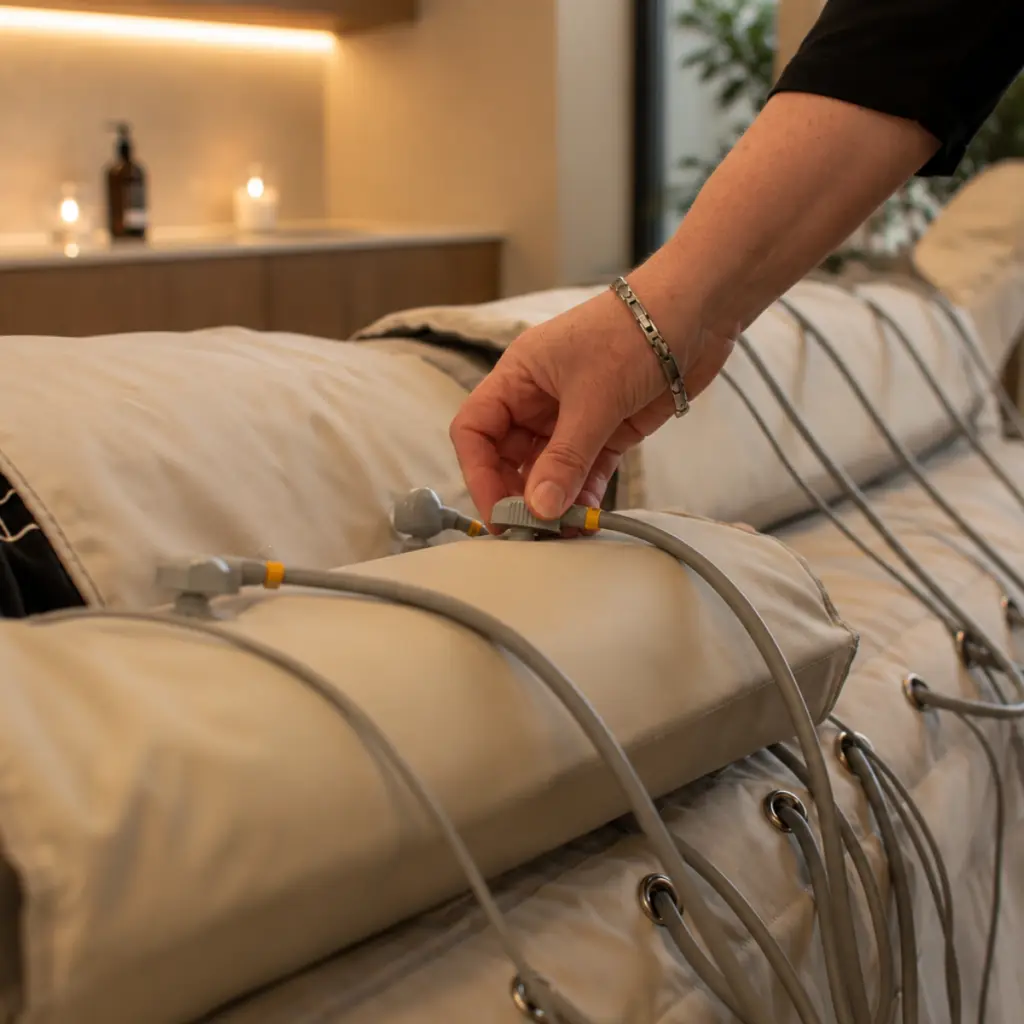
Flowpresso is an FDA Class II cleared device that combines cyclic pneumatic compression and thermotherapy within a practitioner-supervised session.
Its role should be considered in relation to the person’s history, presentation, treatment objectives and suitability for both components.
The useful question is whether Flowpresso has an appropriate place in this person’s care plan.
For some patients, that discussion may follow an established diagnosis and coordination with their treating clinician. For others, further investigation may need to happen first.
Where treatment is appropriate, practitioners should follow current device instructions, contraindications, precautions and professional requirements.
It is also beneficial to explain what the session is intended to achieve without suggesting that one technology addresses every reason someone might swell.
A thoughtful decision to use Flowpresso should be easy to explain why this person, why this intervention and how its value will be assessed.
What is the bigger picture for health and wellbeing?
Swelling can affect far more than appearance. It may change how someone moves, dresses, works or feels about their body.
Taking it seriously means acknowledging those effects while remaining careful about the explanation.
The broader opportunity in lymphatic health is to help people understand how fluid balance connects with the rest of their health.
It also means resisting the idea that every symptom needs to be explained through the modality we offer.
We can advocate for lymphatic health while recognising the contribution of other systems. We can value lymphatic drainage therapy while assessing its role carefully.
Patients deserve both: access to appropriate support and an honest explanation of what we know, what we are considering and what needs further attention.
What are the key takeaways?
- Swelling starts the conversation. It does not determine the treatment.
- Ask about the timeline. What changed, and when, can be highly informative.
- Use the whole history. Medical conditions, medications and surgery provide essential context.
- Recognise when investigation comes first. Referral is a meaningful clinical action.
- Explain the intervention clearly. Patients should understand what is proposed and why.
- Keep the person’s goals visible. Treatment should have a purpose that matters beyond the session.
The question to keep returning to is: “Why might this person be swelling, and what is the most appropriate next step for them?”