

Home / RESEARCH / How Pneumatic Compression May Help the Body Recover

How Pneumatic Compression May Help the Body Recover

How Pneumatic Compression May Help the Body Recover: What the Research Shows

What happens inside your body when you use pneumatic compression after intense exercise?

Intermittent pneumatic compression (IPC) has become increasingly popular as a recovery tool, particularly among athletes and active individuals. But beyond the feeling of lighter, less fatigued legs, what is actually happening physiologically?

A 2023 study published in the European Journal of Applied Physiology investigated exactly this question, looking at how intermittent pneumatic compression affected cardiovascular recovery following intense repeated-sprint exercise.

The findings provide interesting evidence that pneumatic compression may help the cardiovascular system return towards its normal state more efficiently following intense physical exertion.

Bring Lymphatic Care to Your Clinic

*For licensed practitioner and clinic owner inquiries only

The study at a glance

Study: Effects of intermittent pneumatic compression on the recovery of cardiovascular parameters after repeated sprint exercise

Published: October 2023
Journal: European Journal of Applied Physiology
Participants: 16 healthy, physically active adults — 7 women and 9 men
Recovery intervention: 30 minutes of intermittent pneumatic compression
Comparison: Passive recovery with the same sleeves but without pressure

The researchers used a randomised crossover design, meaning each participant completed both recovery conditions. This allowed the researchers to compare each person’s cardiovascular response with and without active compression.

What did participants do?

First, participants completed an extremely demanding exercise protocol: eight 20-second all-out cycling sprints, with one minute of passive recovery between each effort.

Immediately afterwards, they entered a 30-minute recovery period.

During one visit, they received intermittent pneumatic compression. During the other, they wore the same sleeves but without actual pressure — the study’s “Sham” condition.

Throughout the experiment, researchers continuously monitored cardiovascular variables including:

  • Blood pressure
  • Heart rate
  • Stroke volume
  • Cardiac output
  • Peripheral vascular resistance
  • Changes in arterial pressure over time

Measurements were taken before exercise, throughout the recovery period and after recovery.

What did they find?

1. The cardiovascular system returned towards baseline faster

One of the most important findings was that several cardiovascular measures recovered towards their pre-exercise values more quickly when participants used intermittent pneumatic compression.

This included systolic blood pressure, diastolic blood pressure and mean blood pressure.

After the 30-minute recovery period, the researchers found that these measures were closer to participants’ pre-exercise levels following IPC than following passive recovery.

2. Heart function recovered more efficiently

The researchers also observed differences in several measures of heart function.

IPC was associated with a faster return towards pre-exercise values for:

  • Heart rate
  • Stroke volume
  • Cardiac output

The researchers interpreted these changes as indicating a reduction in cardiovascular strain during recovery.

In other words, after putting the cardiovascular system under significant stress through repeated maximal sprints, the body appeared to move back towards its resting state more efficiently when compression was applied.

3. Peripheral vascular resistance recovered towards baseline

Another interesting finding involved peripheral vascular resistance (PVR) — essentially, the resistance to blood flow through the body’s peripheral blood vessels.

During recovery, PVR was closer to pre-exercise levels with IPC than with passive recovery.

The difference was also evident after the recovery period, suggesting that the cardiovascular effects were not limited to the exact moment when the compression was being applied.

Why might compression have this effect?

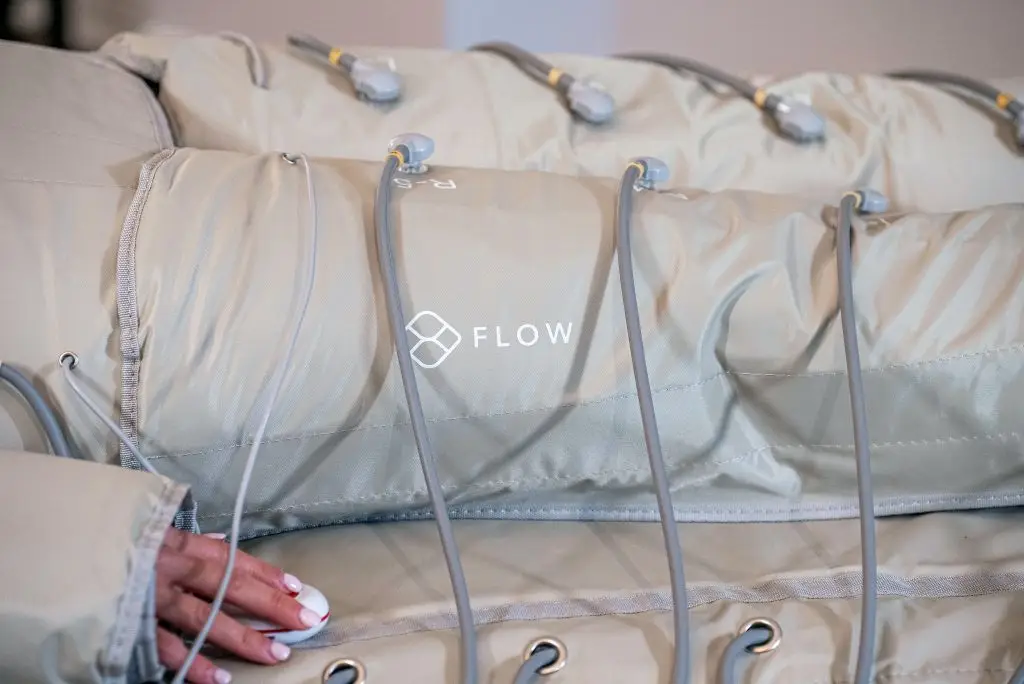
Intermittent pneumatic compression works by applying sequential pressure to the limbs.

In the study, the compression sleeves contained four chambers that inflated sequentially from the foot towards the hip, creating a pressure gradient. The highest pressure was applied to the most distal chamber, at 80 mmHg, with progressively lower pressures moving up the leg.

This type of compression is thought to mechanically assist the movement of blood and fluid through the limbs.

The researchers discuss how IPC can compress veins, empty portions of the venous system and increase blood flow in the direction of the heart. This may increase venous return and influence cardiovascular function.

There may also be effects on the blood vessels themselves. The researchers describe how changes in blood flow and shear stress may trigger biochemical responses within the vascular system.

Could this be connected to the nervous system?

This is where the research becomes particularly interesting. The cardiovascular system is closely connected to the autonomic nervous system — the system involved in regulating functions such as heart rate, blood pressure and circulation. The researchers suggest that the cardiovascular changes observed with IPC could involve modulation of sympathetic and/or parasympathetic activity.

However, there is an important distinction. This study did not directly measure autonomic nervous system activity. The researchers specifically state that they did not assess heart rate variability (HRV), which is commonly used to investigate autonomic regulation.

Instead, they identified this as an important direction for future research. 

What does this mean for recovery?

The study’s findings suggest that intermittent pneumatic compression may help the body transition out of a state of high cardiovascular demand following intense exercise. The authors describe the overall effect as faster cardiovascular recovery and reduced cardiovascular strain.

This could potentially be useful in situations where recovery between training sessions is important, particularly for athletes undertaking multiple sessions in a day. But the implications may extend beyond sport.

The study provides another piece of the puzzle when we think about compression as a modality that doesn’t simply target local muscle recovery, but can influence circulatory and cardiovascular dynamics throughout the body.

What the study doesn't tell us

As with any research, there are important limitations. This was a relatively small study involving 16 healthy, physically active adults, and the participants were accustomed to high-intensity exercise. The researchers also used one specific IPC device, pressure and compression cycle. Therefore, the findings cannot automatically be applied to every compression device, pressure setting or population.

Most importantly, the study looked at a relatively short recovery window. It did not establish whether these cardiovascular changes translate into longer-term improvements in health, performance or wellbeing.

And although the authors discuss possible connections with sympathetic and parasympathetic activity, HRV was not measured. The researchers therefore call for future studies examining these mechanisms directly.

The bigger picture

This research adds to our understanding of what may happen beneath the surface during pneumatic compression. Rather than simply being a passive recovery experience, intermittent pneumatic compression can produce measurable physiological changes. In this study, 30 minutes of IPC following intense exercise was associated with faster recovery of several cardiovascular parameters and reduced cardiovascular strain compared with passive recovery.

The next question is even more interesting:

Could these cardiovascular effects also be connected to the body’s autonomic regulation and our broader experience of recovery and wellbeing?

The authors themselves identify this as an important area for future investigation, particularly through measures such as heart rate variability.  For now, the evidence supports a more measured conclusion: pneumatic compression appears capable of influencing cardiovascular recovery, while the potential relationship between these effects, autonomic regulation and wellbeing remains an important area for future research. 

Key takeaway

The research shows that, following intense exercise, intermittent pneumatic compression can help several cardiovascular measures return towards pre-exercise levels more efficiently and may reduce cardiovascular strain.

That’s an intriguing physiological foundation for understanding why compression-based recovery can feel so restorative and why researchers are continuing to investigate what happens beyond circulation alone.

Reference

Artés, A., Ferrer-Ramos, P., Javierre, C., Viscor, G., & García, I. (2023). Effects of intermittent pneumatic compression on the recovery of cardiovascular parameters after repeated sprint exercise. European Journal of Applied Physiology, 124, 1037–1048. https://doi.org/10.1007/s00421-023-05333-x

Bring Full-Body Lymphatic Therapy to Your Clinic

Flowpresso is a multi-modality system combining:

Perfect for detox programs, recovery protocols, sleep optimization, and emotional wellness.

Select your currency

4th of July Promo

 Get 25% off retail price Flow Vibe II by using the code AMERICA250 

Available 3 July – 12 July 

Only available in USA and New Zealand