


Get the Guides
Download Whitepapers,
Quick Reference Guides, suggested protocols, and more...
Bring Lymphatic Care To Your Clinic
*For licensed practitioner and clinic owner inquiries only.
Understanding the Lymphatic System: What Every Practitioner Should Know
The lymphatic system manages fluid balance, immune surveillance and the clearance of inflammatory by-products — yet it receives a fraction of the attention given to the cardiovascular system in clinical training.
Most practitioners recognise the resulting patient without having a name for them: persistently fatigued, foggy, bloated, stiff, slow to recover, and repeatedly told their test results are normal.
Impaired lymph flow rarely presents as classic lymphoedema. It presents as a cluster of complaints that sit just outside the reason the patient booked.
This guide gives practitioners a working clinical framework. It covers lymphatic and glymphatic physiology and why recent research has renewed interest in both; the everyday factors that slow lymph flow and the signs that point to it; a “drain first” approach to sequencing care; the clinical areas where lymphatic support is worth considering, with evidence levels stated plainly; and a three-step assessment using observation, palpation and functional history that fits inside an existing consultation and requires no equipment.
It closes with self-care strategies to recommend and two models for adding lymphatic services to a practice.
Written for licensed healthcare practitioners.
What you’ll learn from this guide:
- How the lymphatic and glymphatic systems work, and why research interest has accelerated
- The everyday factors that slow lymph flow, and the signs patients report
- A three-step lymphatic assessment you can run inside a standard consultation
- Where lymphatic support fits clinically — with evidence levels stated honestly
- Two models for adding lymphatic services to a practice

Download - Understanding the Lymphatic System Guide
What every practitioner should know. Understanding the Lymphatic System a Whitepaper.
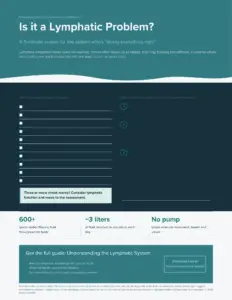
Download - Is it a Lymphatic Problem
Single page checklist and 3 step assessment for practitioners
Is It Lymphatic?
A 5-Minute Patient Screen and 3-Step Assessment
Lymphatic congestion rarely looks like swelling. It more often presents as fatigue, brain fog, bloating, stiffness and slow recovery — in patients whose test results come back normal and who have often been told the problem is stress or age.
This one-page clinical quick reference gives practitioners two tools they can use in their next consultation. The first is a ten-point patient screen covering the symptoms this group reports but rarely volunteers, with a threshold for when to investigate further. The second is a three-step assessment — observation, palpation including the cervical “rope test”, and functional history — that requires no equipment and fits inside an existing appointment.
It also covers the drainage-before-detox sequencing principle and the key figures on lymphatic anatomy.
Designed to be printed and kept in the consulting room. For licensed healthcare practitioners.
Combining Shockwave Therapy and Lymphatic Compression in Chiropractic
Shockwave therapy works locally. It creates a controlled stimulus at a target site to provoke repair, with effects on neovascularization, growth factor release, and the breakdown of calcification and adhesion.
What it does not reach is the systemic side of recovery: fluid and circulation, and the nervous system state of a patient who has just found the session uncomfortable.
That gap is the argument for pairing shockwave with lymphatic compression therapy, and it is a cleaner argument than most add-on pairings, because the two modalities are not doing the same job.
This guide sets out how the combination works in a chiropractic practice. It covers the mechanism and primary effects of each modality side by side, five rationales for running them together, the clinical presentations the pairing suits, and four suggested protocol frameworks covering sequencing before, after and around a shockwave session. It closes with the revenue considerations for a practice adding the service, including session pricing and package structures.
Written for chiropractors and practice owners already running shockwave, or weighing both.
What you’ll learn
- The mechanism and primary effects of each modality, set out side by side
- Five rationales for combining shockwave with lymphatic compression
- Which clinical presentations the pairing suits, from tendinopathy to chronic pain syndromes
- Four protocol frameworks, including whether to run compression before or after the shockwave session
- How the combination affects session pricing, package structure and return on a compression system

Download - Shockwave Therapy and Flowpresso (for Chiropractic Clinics)
Discover the synergistic benefits of combining shockwave therapy with Flowpresso treatments. Complete with clinical applications and suggested protocols.
The 30 Minute Protocol. Incorporate Lymphatic therapy without breaking the schedule
This guide sets out a worked protocol for adding lymphatic compression therapy to a chiropractic practice without reshaping how the day runs. A 20-minute session with ten minutes of setup and reset occupies one 30-minute slot, runs on a timer, and is delivered by trained staff rather than clinician time.
It covers patient selection for neck, shoulder, back and hip presentations, with explicit criteria for who is not a candidate; a minute-by-minute operational flow across setup, session and room reset; suggested starting settings for heat, compression and intensity; and three ways to sequence the session around the adjustment — before, after, or standalone.
It also answers the question every chiropractor asks first: how a therapy applied to the body affects a cervical complaint. The proposed mechanisms are set out with their evidence standing stated plainly, including which claims are not supported and should not be made.
Written for chiropractors and practice owners.
What you’ll learn
- How a 20-minute session fits one 30-minute slot without consuming clinician time
- Patient selection criteria, and who is not a candidate
- A minute-by-minute operational flow for setup, session and room reset
- Suggested starting settings for heat, compression and intensity
- Why a therapy applied to the body affects a cervical complaint — and the evidence standing of each proposed mechanism
- Three ways to sequence it: before the adjustment, after it, or standalone
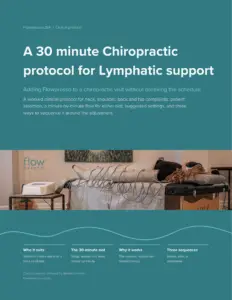
Download - The 30 Minute Protocol (for Chiropractic Clinics)
The 30-Minute Protocol: Adding Lymphatic Therapy to a Chiropractic Visit
Run the Numbers. Estimate Your Revenue Potential
*Revenue figures shown are gross treatment revenue. Break even and first-year ROI also deduct your weekly operating costs and the current Flowpresso purchase price. Financing and taxes are not included. Ask us about financing options, including no payments for the first 6 months.